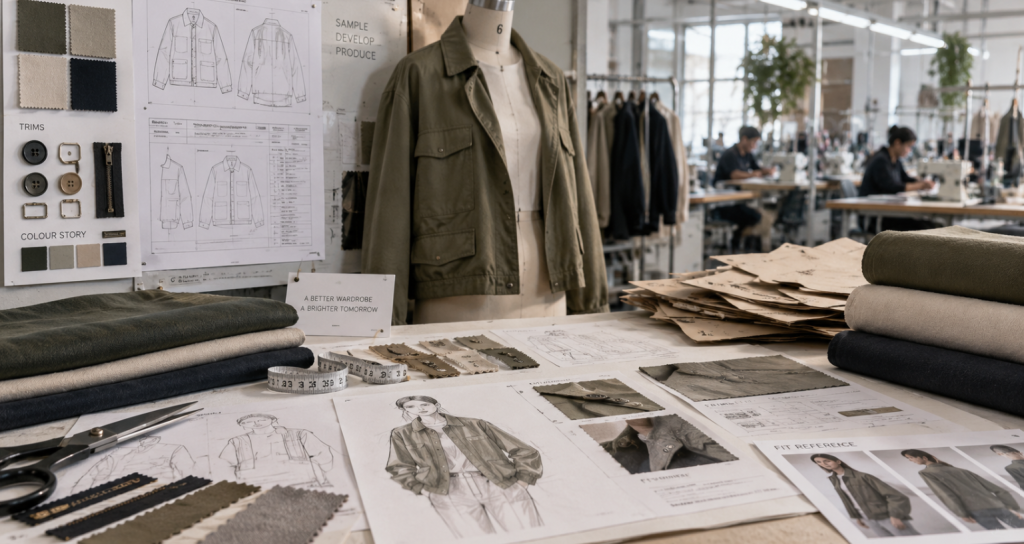
“How much will it cost to make?”
It is one of the first questions a new apparel brand asks. The answer depends on much more than the price a factory quotes for a finished garment.
Fabric, trims, construction, order quantities, sampling, sourcing location and delivery all influence the commercial outcome. Understanding how these elements fit together helps you develop a product that meets its brief at a price your business can support.
At Fluid, we start by looking at those decisions together.
Start with a target price
A target price gives development a practical direction. It helps us assess which fabrics, components and manufacturing options are worth exploring before time and money are spent on sampling.
It also needs to be clear what that price covers. A manufacturing target, a cost including freight and duty, and a retail selling price are different figures.
Consider a simple fabric calculation. If a fabric costs $25 per yard and a garment uses 1.5 yards, the fabric alone costs $37.50. A $19 manufacturing target is already out of reach, before trims, labour or any other costs are included.
Recognising that early allows us to explore alternatives. We might revisit the fabric, simplify the design or discuss whether the target price needs to change.
Understand what goes into the garment
Fabric is often a major part of the cost, but the smaller components deserve attention too.
The type and length of a zip can make several dollars’ difference. Additional pockets introduce material and construction costs. Trims and other details all contribute to the finished price.
Each feature should have a clear purpose. Does it improve performance, comfort or usability in a way the customer will value? Could a different construction or component meet the same need?
These questions help us make informed choices while protecting what matters about the product.
Look at sourcing location and quantity together
A preferred manufacturing country does not automatically fit a target price or order size.
For example, a brief combining Portuguese production, a particular fabric and a $6 T-shirt target may need a substantial rethink. Exploring production in the Far East could offer a different route, but achieving that price would still depend on the specification and volume.
For the kind of low-price brief discussed here, quantities may need to be around 1,000 units rather than 100 or 150. That is an illustration of the relationship between price and volume, rather than a minimum that applies to every supplier.
Minimum order quantities can also apply to fabrics and components. They need to be understood alongside the factory’s requirements.
A lower unit price at a higher volume means committing to more stock. The right decision therefore depends on both the product cost and the size of the order your business is ready to take on.
Allow for development and sampling
The first sample is part of the development process. It gives you something tangible to assess and improve.
Fit, construction or fabric choices may need further work, and two or three stages of sampling can be necessary before a product is ready. Those stages require time and budget.
Changing a material later can also mean revisiting decisions that appeared settled. A replacement fabric may affect the garment’s feel, fit, performance and construction.
A realistic development allowance gives the team room to resolve these issues before committing to production.
Include the cost of getting the product to you
A factory quote needs to be considered alongside its delivery terms. Freight and duty can change what the product ultimately costs to receive.
Sourcing location, shipping arrangements and lead times should therefore be part of the discussion from the beginning. A manufacturing price that looks attractive in isolation may be less suitable once the wider requirements are understood.
The same applies to quality. A product needs to meet its intended use consistently; an unsuitable material or unresolved construction issue can undermine the value of an apparently competitive price.
Make the decisions together
Changing the fabric may affect the cost, performance and available suppliers. Changing the quantity may affect the unit price and stock commitment. Changing the sourcing location may affect minimums and delivery planning.
Our role is to help brands understand those connections and decide where to make adjustments.
A useful starting brief includes the intended use, target price, likely quantities, essential features and desired launch timing. From there, we can assess feasibility and build a more informed route into development.
If you are planning an apparel product, speak to Fluid about the brief before committing to materials or production. Establishing what is achievable early gives the project a stronger foundation.