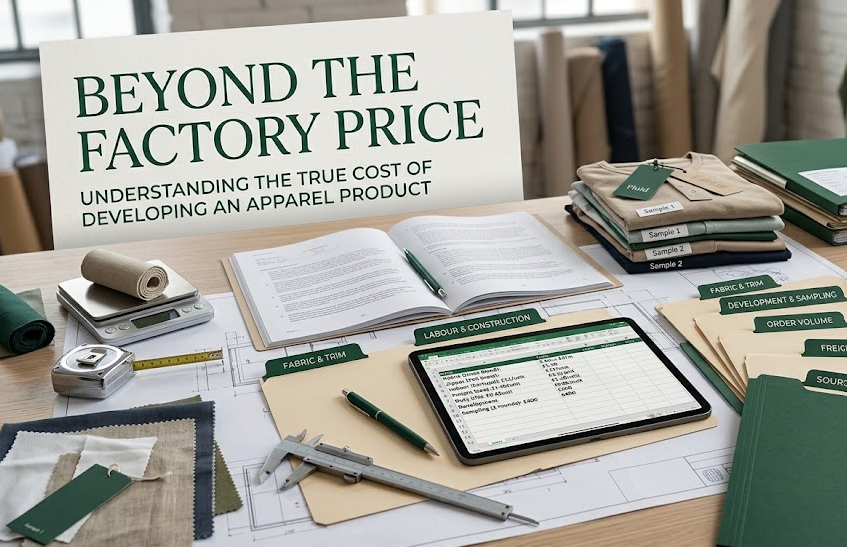
The technical apparel market has seen a rise in well-financed start-ups entering with clear ambition and aggressive growth targets. Strong branding, investor backing, and a defined market opportunity often create early momentum.
However, in apparel, commercial success is rarely determined at launch. It is determined during development.
Where timelines are compressed and decisions are made quickly, underlying product weaknesses can emerge at scale. In technical garments, these weaknesses are often costly to correct.
Speed without structure introduces risk.
What the Apparel Product Development Lifecycle Involves
The apparel product development lifecycle is the structured process of taking a concept through to a commercially viable product.
This typically includes:
- Fabric selection and feasibility assessment
- Prototype development
- Iterative garment sampling
- Performance and wear validation
- Cost modelling and margin alignment
- Bulk production planning
Each stage serves a defined purpose. Together, they create a controlled pathway from idea to market-ready product.
The Risk of Direct-to-Factory Sourcing
For many start-ups, the instinct is to move directly to a factory to accelerate production. While this can appear efficient, it often removes critical layers of technical and commercial oversight.
Without structured development support, a number of key questions become difficult to answer with confidence:
- How do you identify a supplier that is genuinely suited to your product?
- Are you being offered a commercially fair and sustainable price?
- Does the supplier have proven expertise in the specific category you are developing?
- How do you distinguish between production-led guidance and advice that is genuinely aligned to your brand’s long-term interests?
Factories are, by nature, focused on securing production. Their role is to manufacture, not necessarily to guide product strategy, refine commercial models, or challenge assumptions during development.
This creates a gap between making a product and building a viable apparel business.
Why the Garment Sampling Process Matters
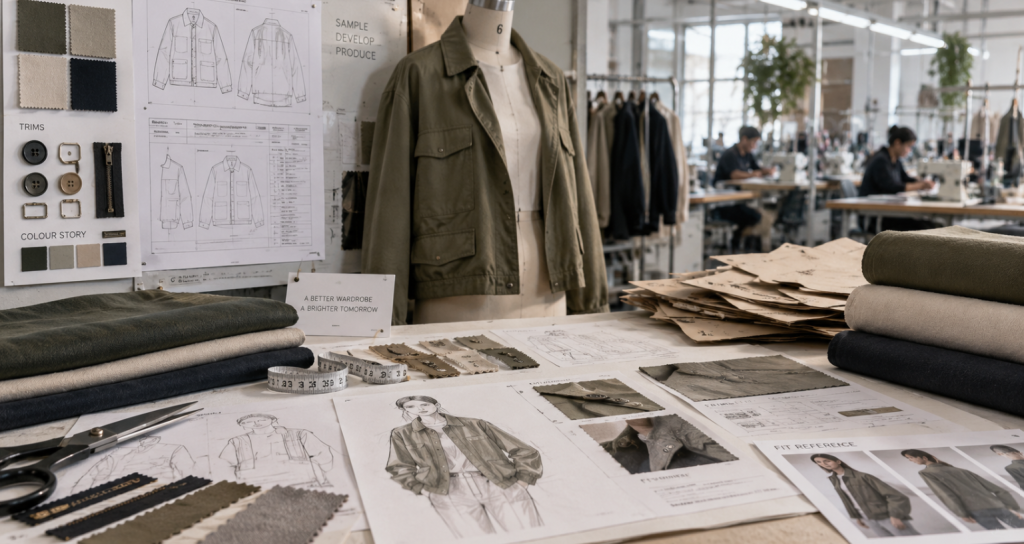
The garment sampling process is one of the most important stages in apparel product development. It is where assumptions are tested and refined.
A structured sampling approach enables:
- Validation of fabric behaviour under movement
- Refinement of fit across size ranges
- Adjustment of construction techniques
- Testing of durability through repeated wear and washing
- Confirmation of production feasibility
Each iteration reduces uncertainty and increases confidence ahead of scale.
Commercial Impact: Margin, Returns and Scalability
For start-ups with strong financial backing and growth targets, the commercial impact of development decisions is significant.
Without structured development:
- Cost assumptions may not hold at scale
- Product inconsistencies can lead to returns
- Supplier pricing may not be benchmarked effectively
- Early production decisions can reduce long-term margin
With structured development:
- Pricing is better understood and validated
- Product performance is more consistent
- Suppliers are selected based on suitability, not convenience
- Scaling becomes more predictable
Technical discipline supports commercial clarity.
Building a Repeatable Development Framework
The difference between launching a product and building a sustainable apparel business lies in repeatability.
Structured apparel product development creates:
- Clear processes
- Defined checkpoints
- Consistent quality outcomes
- Stronger supplier alignment
For ambitious brands, this framework becomes a competitive advantage.
Process Control as a Growth Enabler
In technical apparel, expertise is expressed through process rather than speed.
A controlled development lifecycle allows brands to move forward with confidence, knowing that products have been validated, costs are understood, and risks are managed.
Structured development is not a constraint on growth.
It is what enables it.
Considering Your Next Stage of Development?
For brands looking to move from concept to commercially viable product, structured development can significantly reduce risk and improve long-term performance.
If you’re exploring how to bring a product to market — or refine an existing range — Heather and the Fluid team are always happy to have an initial conversation.